01
Report
The worker flags the condition by voice, with evidence, even without a network.
Anomaly reporting
The worker reports by voice, in seconds. The supervisor listens, validates and prioritizes. Information flows between the two, and no longer gets stuck along the way.
Today
Much of what happens underground is seen by someone. What's missing is a reliable path between that observation and the person who can act on it.
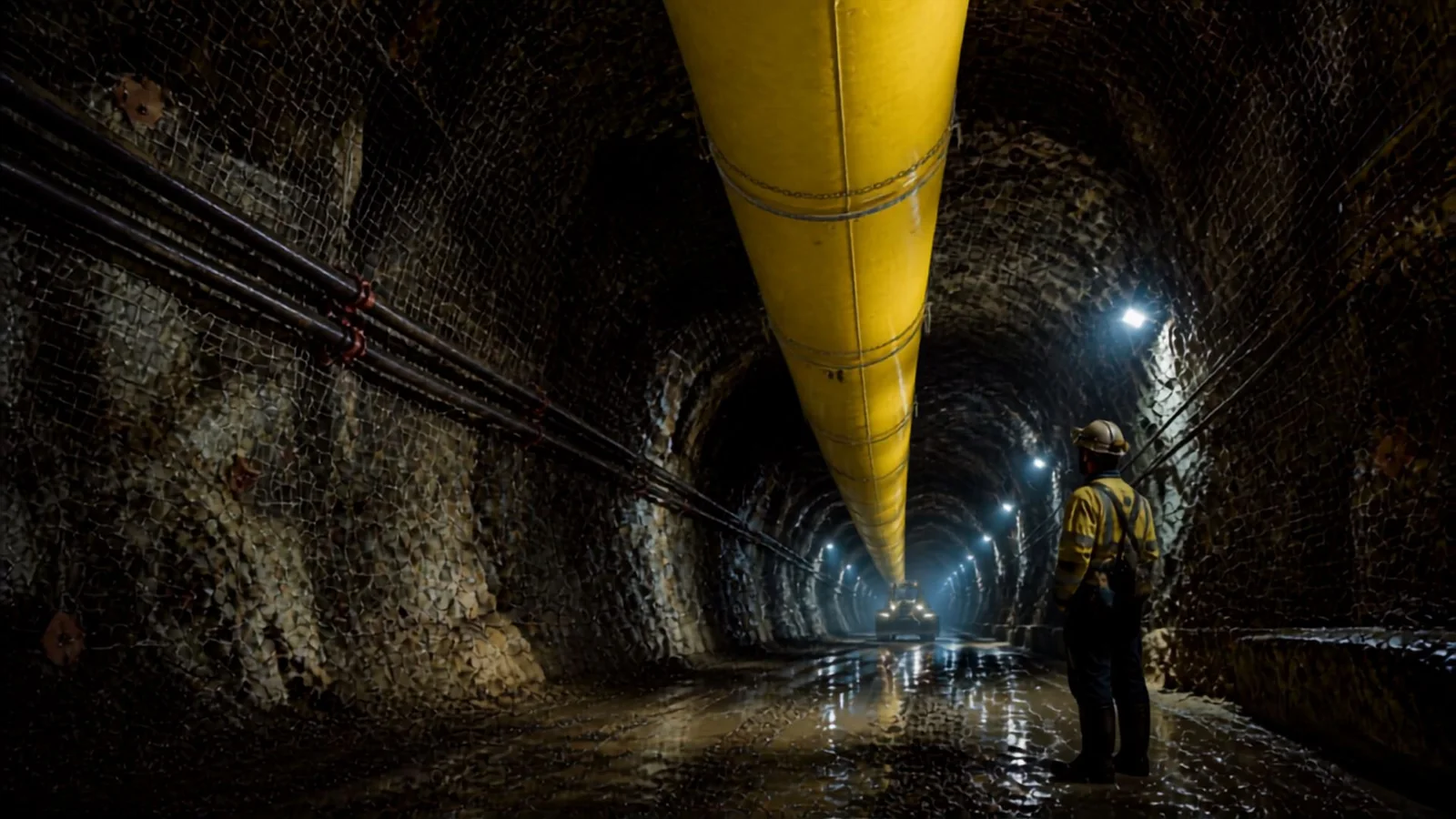
Mesh down on the floor, water building up, a torn-down vent duct. The observation gets passed along over the radio, at the end of the shift or in passing in the corridor, and some of it never reaches anyone.
Information reaches them in bits and pieces, often with no evidence and no precise location. To get an accurate picture, they have to go and see, and in the meantime the condition stays in place.
With no record, nobody knows whether the situation was handled. The same conditions come back from one shift to the next, and when an incident happens, the history you're looking for doesn't exist anywhere.
Why voice
A worker wearing gloves, in the noise, seven hundred meters underground, isn't going to write a report. They'll say it. That's how information really moves in a mine, and that's what the tool is built on. Reporting happens the way the event does: a voice note, a photo, a short video, and the location attaches itself. No procedure to memorize, no form to look for.
That choice has a direct effect on what the supervisor receives. A fifteen-second voice note conveys what a text field never will: the context, the perceived urgency, the exact vocabulary of the trade. They no longer have to piece the situation together; they hear it.
The supervisor at the center
A report isn't a work order. It reaches the supervisor with its evidence, its location and the voice of the person who made it, and it's the supervisor who assesses its scope. They validate what needs validating, set aside what has no reason to go further, rank the rest by their own priorities and dispatch from the field, without going back through the office.
That filter is what makes the system sustainable. Without it, a reporting tool ends up feeding the maintenance and operations systems with everything that comes through. Here, nothing flows down into your systems unless a responsible person has reviewed it.
And the loop closes. The person who reported sees what becomes of their report, who took it on and when it was resolved. That response is what keeps communication going over time: when reporting produces a visible result, the field keeps reporting.
What changes
| The condition is passed along over the radio | The condition is logged with its evidence and the voice of the person who saw it |
| The supervisor has to go and see to assess it | They assess it on the evidence, from the field |
| The person who reported never learns what happened next | They see the status change all the way to closure |
| The same conditions keep coming back | History by location and by type becomes searchable |
| Field information stays cut off from production | Actual conditions feed planning |
From the field to production
A cluttered ramp, ventilation out of service, a blocked access. These are conditions that decide what can be done tomorrow, and they're often discovered when the crew shows up on site. Logged and validated when they are observed, they stop being surprises for production.
Shift after shift, these reports build a picture of what's really happening on site. Planning then stops making do with information pieced together after the fact, and works from known conditions.
What makes the scenario work
By voice, offline, with event types preconfigured for each trade.
They assess on the evidence, prioritize by their own rules and dispatch without going back through the office.
A searchable history, from report to closure, visible to the person who reported it.
Who it's for