With the sheer number of artificial intelligence (AI) tools and models available today, picking the right approach for your specific needs can be hard. Generative AI models, for example, are often praised for their versatility and their ability to create content from various kinds of data. But it’s easy to use them inappropriately, which can mean weaker performance than models built specifically for a given task.
To get the most out of AI models, it’s crucial to start with a clear definition of the task at hand. AI tasks are generally classified by their action and by the type of data they handle. This article aims to clarify those different tasks, illustrate their specific applications in mining, and guide professionals toward the tools and models best suited to their needs.
The main tasks covered here are:
- Classification: assigning categories or labels.
- Regression: estimating continuous, numerical values.
- Object detection: identifying and locating objects in images.
- Segmentation: dividing an image into distinct segments or zones.
- Anomaly detection: identifying atypical behaviour or data.
- Content generation: creating text, images or other kinds of content.
Reinforcement learning — a learning method that applies more to tasks such as sequential decision-making and optimizing actions over time — is also covered.
For each task, this article gives concrete application examples based on the kinds of data involved, such as:
- Images
- Text
- Tabular or time-series data
- Multimodal, a combination of several types
We also suggest relevant algorithms and models for each task, along with tool suggestions for retraining those models on specialized data.
Classification
A classification task assigns a category or labels to the data.
A classification task can be:
- Binary — only two possible categories, such as present or not present.
- Multi-class — more than two possible categories but a single label per image, text, series and so on.
- Multi-label — more than two possible categories, with the option of assigning several independent, non-exclusive labels to the same piece of data.
IMAGES
Where the input is an image, this might mean classifying the type of equipment photographed (multi-class), doing quality control on machinery components (binary: accepted or not), labelling the different minerals present in a single image (multi-label), and so on.
Models worth considering: ResNet (Residual Networks), ViT (Vision Transformer)
MULTIMODAL
Some multimodal models were developed to classify an image accompanied by text. By phrasing that text well or adding concrete examples, these models can sometimes classify an image without specific retraining. That is zero-shot learning (no prior example) or few-shot learning (with a handful of examples).
Of course, in a highly technical and specific setting, retraining may be necessary.
Model worth considering: CLIP (Contrastive Language-Image Pre-Training)
TABULAR
Take the inspection of critical equipment such as mills or ground support structures. A classification model can be trained on tabular data from various ultrasound sensors to automatically identify structural defects from thickness and density measurements.
Models to retrain: XGBoost (Extreme Gradient Boosting)
Regression
Regression predicts or estimates a continuous, numerical value.
TABULAR TIME SERIES
For example, predicting equipment maintenance costs could draw on historical data such as operating hours, temperatures and equipment vibration over time.
Models to retrain: XGBoost (Extreme Gradient Boosting)
Anomaly detection
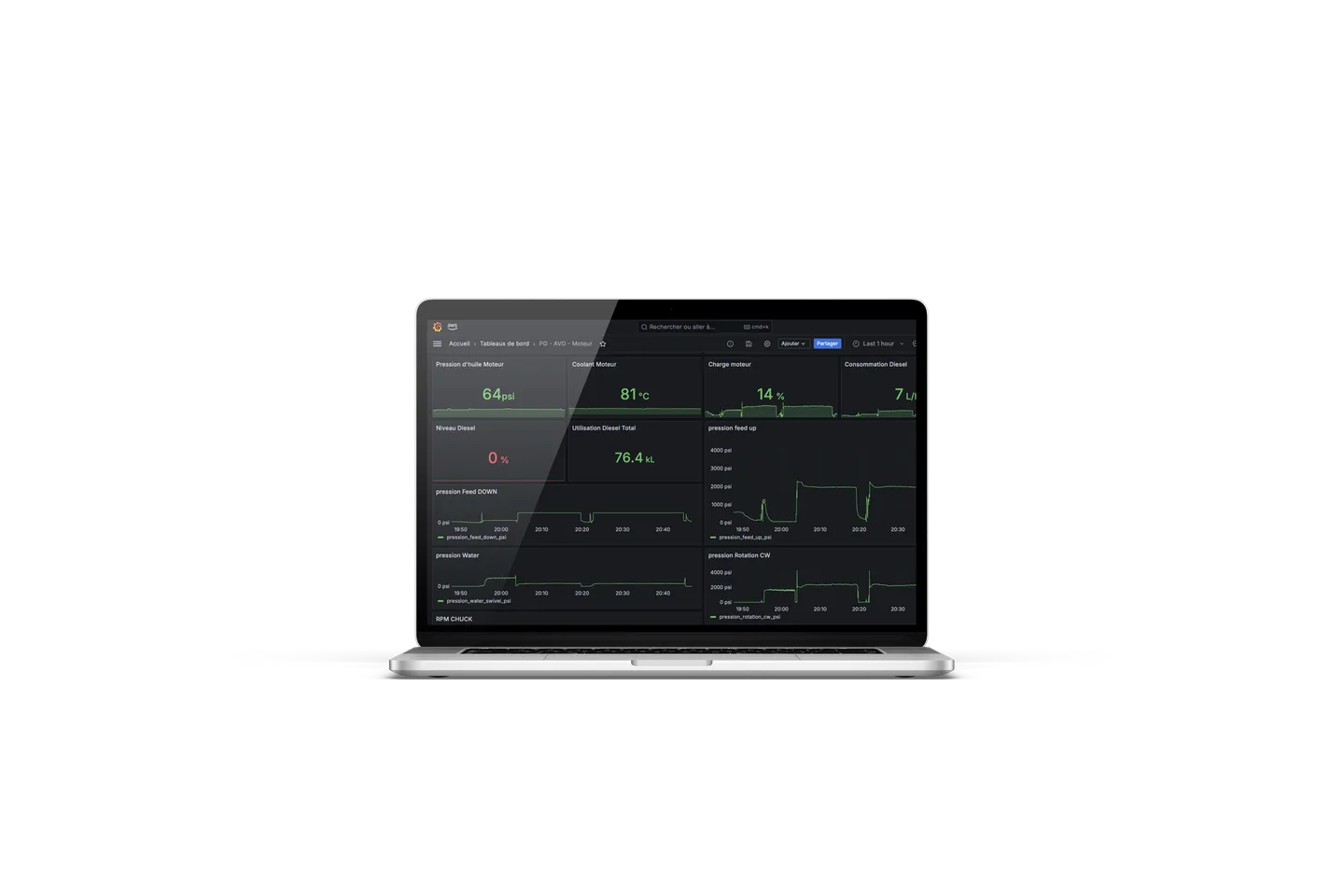
Identifying behaviour or data that departs from the norm, which may be caused by errors or unusual events. Anomaly detection is most often used on time-series data (IoT sensor signals).
TABULAR TIME SERIES
One example would be detecting anomalies in temperature, power consumption and vibration data from equipment in order to predict breakdowns.
Algorithms/models worth considering: Isolation Forest (see the Scikit-Learn example)
Object detection
Identifying and locating specific objects in an image, generally with bounding boxes. This task is more specific to images.
IMAGES
For example, an object detection model can be used to detect people in a hazardous zone and trigger an automatic machinery stop to avoid accidents.
Models to retrain: YOLO (You Only Look Once)
Segmentation
Segmentation means dividing an image into distinct regions or segments to identify objects or parts of objects. This task is also more specific to images.
IMAGES
Segmenting satellite images could make it possible to delineate different zones such as forest cover, bodies of water and roads, and to analyse their size, distribution and change over time.
Models worth considering: Segment Anything Model (SAM, by Facebook)
Content generation
Content generation is the specialty of large language models (LLMs). Within content generation you’ll find more precise sub-tasks such as:
- Summarizing information, answering questions,
- Translating,
- Generating images or video from text,
- Generating code,
- And so on.
It’s easy to assume generative AI can also handle classification, regression, object detection and anomaly detection, but that isn’t quite the case.
For instance, LLMs can be used for text classification tasks by setting up detailed context, but purpose-built models such as BERT are often more effective. For image or tabular data classification, specialized models are more appropriate too.
For tabular data, LLMs can be used to generate queries that aggregate and then interrogate the data.
In general, LLMs aren’t designed for tasks like classification, regression or object detection directly. Those tasks usually need specialized models and architectures better suited to the data types and specific objectives.
For multimodal generative models or image generation, an LLM is usually part of a more complex architecture that handles processing and/or generating images.
IMAGES
A generative model could create a realistic illustration (photo) of a concept from a description. For generating functional diagrams, it’s better to generate them in a text/code format.
Available models: DALL-E (by OpenAI), Gemini (by Google), Stable Diffusion (by Stability)
TEXT
An LLM could assist an expert in writing maintenance reports.
Available models: GPT (by OpenAI), Llama (“open-source”, by Meta), Claude (by Anthropic), Titan (by Amazon), Gemini (by Google)
MULTIMODAL
A multimodal model could generate summaries of maintenance reports assembled from both text data and inspection images.
Available models: Claude (by Anthropic), Gemini (by Google)
Reinforcement learning
Reinforcement learning is a branch of AI in which an agent learns to make sequential decisions in order to maximize a reward. Unlike supervised learning, where models are trained on annotated data, RL uses trial and error to learn the best decision strategies. The agent receives rewards or penalties based on its actions, which guides its learning and its future choices.
This type of learning is used more in applications where you need to explore various options before finding the optimal strategy. For example, this kind of AI could be used to adjust recipes and improve output quality based on the ore type and dozens of other parameters.
Tools worth considering: TensorFlow Agents (a library for implementing and designing algorithms)
In closing, there is a wide range of models and tools suited to various tasks — classification, regression, anomaly detection, segmentation, object detection, content generation and sequential decision-making.
Platforms such as Hugging Face offer a broad selection of pre-trained models, which can be used as-is or retrained on your own data.
To get the best results, it’s essential to understand your needs clearly and select the approach best suited to your objectives. And of course, we can guide you through identifying and implementing the most effective solutions for your projects.